![[personal profile]](https://www.dreamwidth.org/img/silk/identity/user.png)
Here's a complete gravestone epitaph analysis that I cut from the main post because archaic Chinese is difficult and I was getting impatient so I posted first haha.
(Also known as with the help of traditional Chinese dictionaries, Baidu and bilibili, I attempt to read between the lines)
In traditional recorded history, Princess Taiping and Shangguan Wan'er had basically no interaction. However, in Shangguan Wan'er’s gravestone epitaph, there is a specific line that records,
太平公主哀伤,赙赠绢五百匹,遣使吊祭,词旨绸缪。
Translation: [Upon hearing Shangguan Wan'er's death], Princess Taiping sank into sorrow. She donated five hundred bolts of fabric [for funeral use], and sent a representative to pay respects, the words of the eulogy written with heartbroken longing.
There interesting thing her is that the phrase 绸缪 chou mou comes from a Shijing (The Odes) article Bin Feng Chi Xiao, and it mostly denotes the fierce love between couples, and has many other uses within Chinese literature history describing such. The fact that this phrase is used here is a huge sign that WanPing's relationship went deeper than first surmised.
Basically, what this line is saying that Princess Taiping donated the capital to make Wan'er's funeral a grand affair, and sent someone before her coffin to pay respects and read the eulogy that she wrote for Wan'er. This particular eulogy had some strong wording that made people describe it as 'chou mou', which in other uses, points to fierce love between regular couples.
Also, there's the final two lines of the epitaph:
(Also known as with the help of traditional Chinese dictionaries, Baidu and bilibili, I attempt to read between the lines)
In traditional recorded history, Princess Taiping and Shangguan Wan'er had basically no interaction. However, in Shangguan Wan'er’s gravestone epitaph, there is a specific line that records,
太平公主哀伤,赙赠绢五百匹,遣使吊祭,词旨绸缪。
Translation: [Upon hearing Shangguan Wan'er's death], Princess Taiping sank into sorrow. She donated five hundred bolts of fabric [for funeral use], and sent a representative to pay respects, the words of the eulogy written with heartbroken longing.
There interesting thing her is that the phrase 绸缪 chou mou comes from a Shijing (The Odes) article Bin Feng Chi Xiao, and it mostly denotes the fierce love between couples, and has many other uses within Chinese literature history describing such. The fact that this phrase is used here is a huge sign that WanPing's relationship went deeper than first surmised.
Basically, what this line is saying that Princess Taiping donated the capital to make Wan'er's funeral a grand affair, and sent someone before her coffin to pay respects and read the eulogy that she wrote for Wan'er. This particular eulogy had some strong wording that made people describe it as 'chou mou', which in other uses, points to fierce love between regular couples.
Also, there's the final two lines of the epitaph:
潇湘水断,宛委山倾。珠沉圆折,玉碎连城。
甫瞻松槚,静听坟茔。千年万岁,椒花颂声。
Translation: As if the flowing water halts, the mountains are listing and crumbling. As if the round pearls sinking, a city’s worth of jade shattering. Staring off at the pine in front of the tomb, listening to the wind. Even after thousands of years, may people chorus your name as I do.
There's also a notable reference in the last quartet of characters: 椒花颂声 (jiao hua song sheng). 椒花颂 (jiao hua song) is an article written by a notable female author in the Jin dynasty (during a unified period of ancient Chinese history) that was she gave to her husband as a proof of their love. Later, this term in general also generally denotes 'women of talent'. So, I rendered it as 'may people chorus your name [as a woman of extreme talent] as I do.'
These are the lines that still continue to be repeated whenever Shangguan Wan'er's gravestone epitaph is mentioned. Not to mention the astounding use of literary references and how well these two lines flow, they perfectly convey the commissioner's longing for the tomb's owner, or, as previously mentioned, most likely Princess Taiping's true feelings towards Shangguan Wan'er.
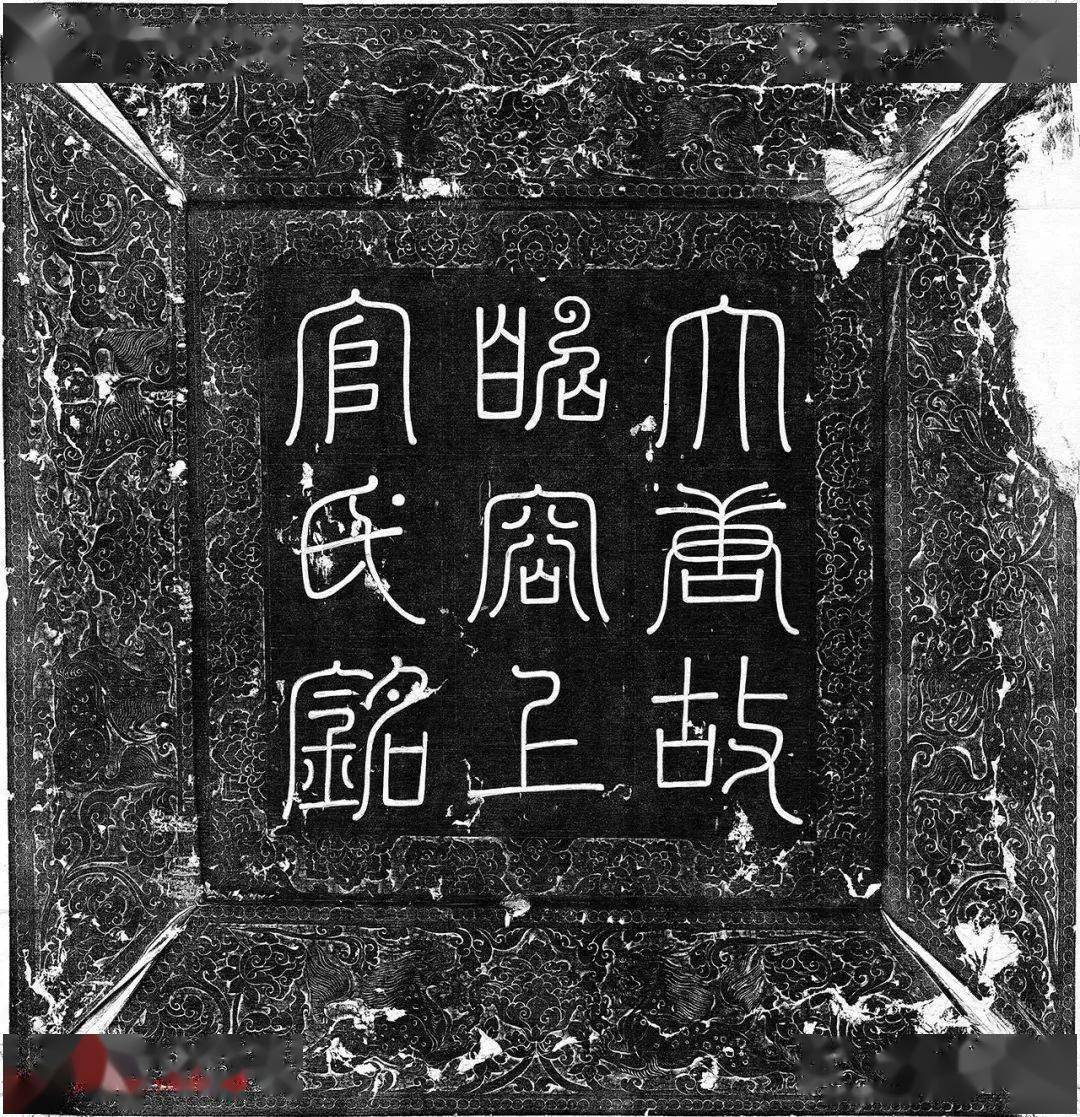
cover of Shangguan Wan'er's gravestone epitaph. Credit: Shanxi Archeological Museum
Translation: As if the flowing water halts, the mountains are listing and crumbling. As if the round pearls sinking, a city’s worth of jade shattering. Staring off at the pine in front of the tomb, listening to the wind. Even after thousands of years, may people chorus your name as I do.
There's also a notable reference in the last quartet of characters: 椒花颂声 (jiao hua song sheng). 椒花颂 (jiao hua song) is an article written by a notable female author in the Jin dynasty (during a unified period of ancient Chinese history) that was she gave to her husband as a proof of their love. Later, this term in general also generally denotes 'women of talent'. So, I rendered it as 'may people chorus your name [as a woman of extreme talent] as I do.'
These are the lines that still continue to be repeated whenever Shangguan Wan'er's gravestone epitaph is mentioned. Not to mention the astounding use of literary references and how well these two lines flow, they perfectly convey the commissioner's longing for the tomb's owner, or, as previously mentioned, most likely Princess Taiping's true feelings towards Shangguan Wan'er.
cover of Shangguan Wan'er's gravestone epitaph. Credit: Shanxi Archeological Museum


